
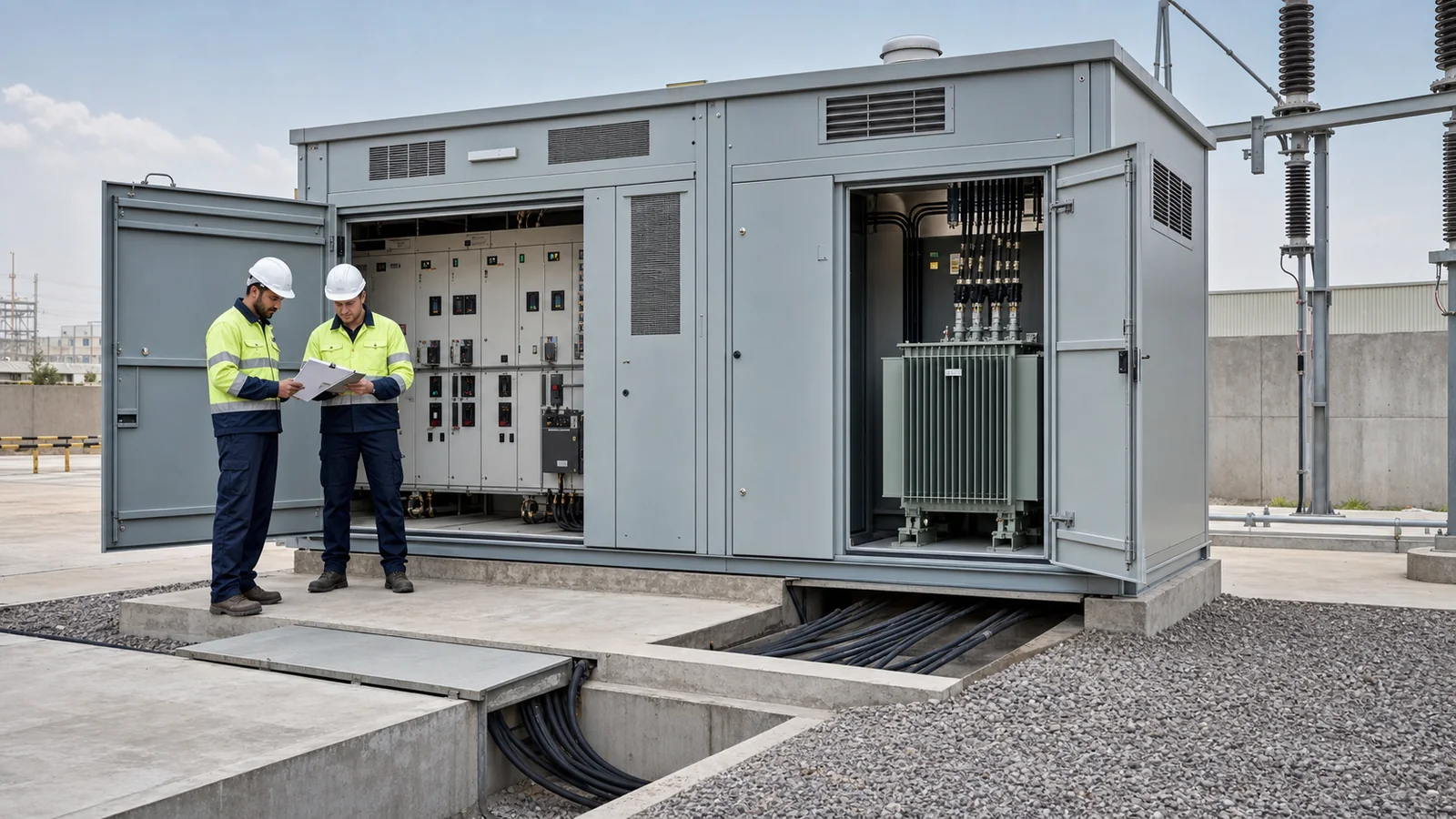
Compact Substation RFQ: Interface Checks Before Ordering
A compact substation is often purchased to simplify site work, but it is not a single-product decision. It combines enclosure, transformer, medium-voltage switching, low-voltage distribution, cable compartments, ventilation, protection, metering, and civil interfaces. If those interfaces are unclear before ordering, the package can still delay foundation work, cable pulling, utility review, installation, or commissioning.
The short answer is: a compact substation RFQ should define the single-line diagram, equipment boundary, cable entry, foundation interface, access clearances, enclosure environment, earthing arrangement, utility metering needs, protection/control interfaces, and document deliverables. Final approval still depends on project drawings, supplier documents, local code, utility requirements, AHJ review, factory test reports, and commissioning procedures.
Use this as a procurement checklist. It does not replace the electrical designer, EPC, utility reviewer, registered engineer, or local authority.
Treat the substation as an interface package
A compact substation may look like a finished metal enclosure, but the purchase succeeds only when every connection point is understood. The transformer, switchgear, enclosure, foundation, cable trench, ventilation path, drainage, public access risk, lifting method, and door swing all interact.
That is why a request such as “one 1250 kVA compact substation, 11 kV/0.4 kV” may support an early budget, but not a purchase order. The RFQ should state what connects to each side of the package and who owns each boundary.
RFQ interface matrix for compact substations
This matrix is not a universal design standard. It helps buyers, EPCs, and plant engineers compare quotations before drawings are frozen.
| RFQ interface | Why it changes the order | What the buyer should provide or request |
|---|---|---|
| Single-line diagram and operating mode | Source arrangement, transformer rating, LV incomers, bus couplers, feeders, standby source, and future expansion affect layout. | Provide the latest single-line diagram, operating mode, utility boundary, metering location, and any future feeder or second-transformer space requirement. |
| Medium-voltage side | The MV compartment may include switching, metering, protection relay, surge arresters, cable termination, or utility seal points. | State MV voltage, frequency, fault-study basis, switching function, protection need, utility metering rule, cable type, and whether MV equipment is inside this scope. |
| Transformer compartment | Oil-filled and dry-type compartments raise different ventilation, fire, oil containment, noise, access, and monitoring questions. | Confirm transformer type, rating, voltage ratio, impedance target if specified, tap arrangement, cooling, alarms, temperature monitoring, access door, and removal path. |
| Low-voltage side | Main breaker, feeders, capacitor compensation, metering, ATS, communication, and outgoing cable routes change footprint and heat. | Provide feeder schedule, breaker ratings for engineering review, cable sizes, cable entry direction, metering/CT scope, spare space, and BMS/SCADA signal needs. |
| Cable entry and foundation | Bottom entry, side entry, trench depth, gland plates, cable bending, and slab openings are often found too late. | Send foundation drawing, trench route, entry direction, gland plate needs, civil limits, floor level, flood risk, and lifting/handling route. |
| Enclosure and environment | IP rating, corrosion protection, solar exposure, dust, humidity, condensation, security, and public access change enclosure details. | State location, ambient range, altitude, corrosive exposure, dust/moisture level, required IP or NEMA concept where applicable, heaters, ventilation, locks, and signage rules. |
| Earthing and bonding | Neutral treatment, cable shield earthing, enclosure bonding, tank earthing, and ground-fault behavior are project-specific. | Provide grounding requirements, neutral arrangement, utility rule, local code basis, earth bar location, and responsibility for connection to the site grounding grid. |
| Documents and acceptance | Missing drawings and terminal lists delay civil work, cable procurement, utility approval, and commissioning. | Request outline, foundation, single-line and wiring drawings, terminal list, accessory schedule, nameplate data, packing list, test reports, and agreed language before shipment. |
Start from the single-line diagram, not the enclosure size
Many compact substation problems start with layout discussion before the electrical boundary is clear. The project team should first confirm whether the package receives one utility source, two ring-main cables, a generator or solar interface, or a standby feed, and whether the LV side is a main breaker, feeder lineup, or board with compensation and metering.
This matters because switchgear is not just a cabinet. Breaker duty, interlocks, relays, bus arrangement, CT locations, cable termination, and metering boundaries all affect space, heat, wiring, and commissioning tests. The enclosure should follow those engineering decisions.
Cable entry and civil details can change the layout
For overseas projects, cable entry is a common RFQ gap. A drawing for bottom entry above a cable trench may not work for side entry from underground ducts. A catalogue door arrangement may clash with a wall, fence, nearby equipment, cable pulling route, or maintenance path.
Before manufacturing is frozen, buyers should confirm foundation dimensions, trench opening, lifting points, unloading route, door swing, removable panels, ventilation clearance, and major-component removal access. For outdoor yards, review flood level, drainage, security, public access, and corrosion exposure. The broader site-condition RFQ checklist is useful because compact substations concentrate many environmental assumptions into one package.
Enclosure requirements need site context
An enclosure label does not by itself prove site suitability. Where IP codes are specified, IEC 60529 is commonly referenced for degrees of protection provided by enclosures. Some projects may use NEMA, ANSI, GB/T, utility, or local enclosure concepts instead. The RFQ should state which system applies and what site exposure it is meant to address.
Even then, IP or enclosure type is only one part of the question. Ventilation openings, filters, louvers, heaters, paint system, hardware, door seals, locks, and service clearances also matter. In humid, dusty, coastal, high-altitude, public-access, or high-solar-load sites, review the enclosure as an operating environment, not a simple shell.
Keep transformer and switchgear scope traceable
Transformer data, MV switching data, LV panel data, and accessories should stay traceable through quotation, drawing approval, factory inspection, shipping, receiving, and commissioning. This is especially important when different parties handle the enclosure, protection settings, metering approval, or downstream panels.
Buyers should request a clear boundary schedule showing which devices are included inside the substation, which are supplied loose, which terminals are brought to user connection points, and which functions belong to the project protection and control design. The transformer accessories and alarm contacts checklist can help build the signal and accessory portion.
Before equipment is released for shipment, the datasheet, drawings, terminal list, packing list, and test documents should describe the same scope. After delivery, the receiving team should protect that evidence; the receiving inspection and temporary storage checklist covers that handover stage.
Standards are references, not the approval path
Standards help buyers and suppliers use the same technical language, but they do not replace the project specification. Transformer requirements may refer to IEC 60076-1 where IEC practice applies. Compact substation projects may also reference high-voltage switchgear, prefabricated substation, enclosure, utility, IEEE, ANSI, GB/GB/T, fire, seismic, or local installation requirements.
These references are not globally interchangeable. A package for one utility, country, mine, park, renewable site, or commercial building may need different approval evidence from another. The RFQ should name the applicable market, project standard, utility rule, and authority review path. Final acceptance should come from approved drawings, final datasheets, test reports, site inspection, and commissioning procedures.
RFQ wording buyers can adapt
“Please quote the compact substation based on the attached single-line diagram, site layout, cable trench drawing, utility requirements, and project specification. Identify the transformer, MV switchgear, LV switchgear, enclosure, metering, protection, auxiliary power, earthing, and accessory scope.”
“Submit outline drawing, foundation drawing, cable entry details, ventilation arrangement, door swing, service clearance, lifting method, terminal list, wiring diagram, accessory schedule, and packing list for approval before manufacturing.”
“State the applicable standards or local rules used for transformer, switchgear, enclosure, earthing, testing, documentation, and site acceptance. Do not assume that IEC, IEEE, ANSI, NEMA, GB/T, utility, DOE, EU, or local requirements are interchangeable unless the project documents say so.”
“Final design remains subject to approved project drawings, utility review, local code, AHJ requirements, supplier datasheet, factory test report, and commissioning tests by qualified personnel.”
A practical decision rule
A compact substation is ready for procurement only when the project team can answer three questions: what connects to each side of the package, what conditions the enclosure must survive, and what documents will prove the supplied scope. If any of those answers are missing, pause the purchase discussion and request clarification before treating quotations as comparable.
The goal is not to make the RFQ longer for its own sake. The goal is to prevent a compact substation from becoming a site-built problem hidden inside a factory-built enclosure.
