
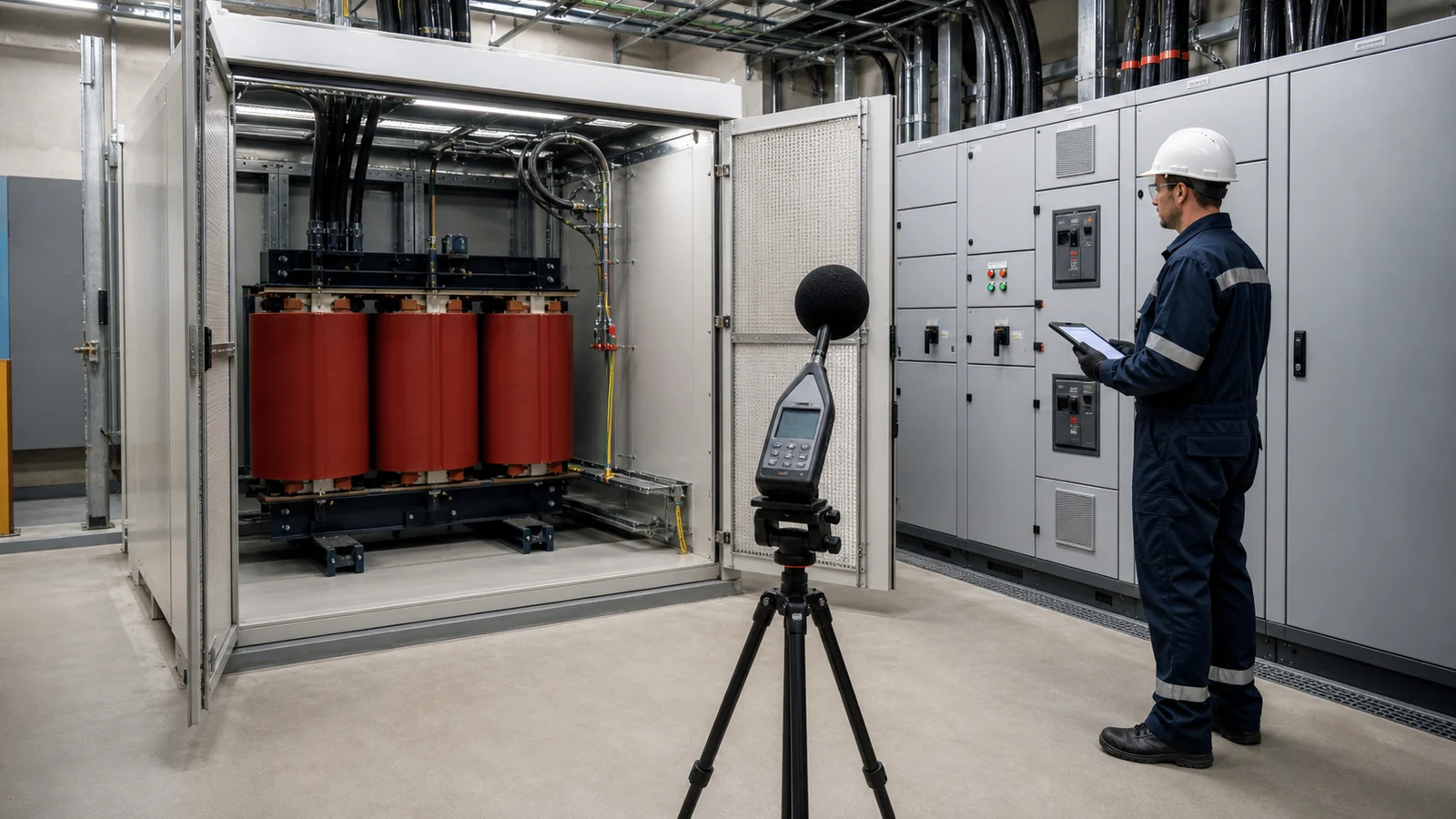
Transformer Noise RFQ: Acoustic Limits Buyers Should Set
A transformer can satisfy the electrical specification and still become a project problem if it is too audible at the wrong boundary: a hotel plant room above occupied space, a hospital electrical room near treatment areas, a factory transformer bay beside offices, a mine substation close to accommodation, or an outdoor compact substation near a property line.
The short answer is: do not ask only for a “low-noise transformer.” A useful RFQ should state the required acoustic criterion, measurement basis, installation location, expected operating condition, cooling accessories, enclosure or room layout, nearby receivers, document evidence, and responsibility for site acoustic control. Final sound limits and acceptance still depend on project specifications, local ordinances, utility rules, building design, AHJ review, supplier datasheets, factory test reports, and qualified acoustic or electrical engineering review.
This guide helps procurement teams, EPCs, plant engineers, commercial-building owners, industrial parks, mines, and renewable-energy projects ask better questions before ordering. It does not replace an acoustic consultant, registered electrical engineer, utility reviewer, site testing contractor, or local authority.
Factory sound data is not the whole site result
Transformer sound is usually generated by core magnetostriction, winding and tank vibration, cooling fans, pumps where used, enclosure panels, and connected structures. A factory sound level can help compare options, but it is not the same as the sound heard in a finished building or yard. Room volume, wall stiffness, ventilation openings, cable trenches, floor vibration, reflective surfaces, doors, louvers, barriers, and background noise can all change the site result.
That is why the RFQ should separate two questions:
- What sound data will the transformer supplier declare or test for the quoted unit?
- What site acoustic criterion must the installed system meet at the receiver location?
The supplier can usually help with product-side data and design options, subject to the final datasheet and test basis. The owner, EPC, acoustic consultant, and local authority must confirm the installed system requirement. A transformer manufacturer cannot reliably promise a property-line or bedroom noise result without the project acoustic model and site conditions.
Acoustic RFQ matrix for transformer purchases
Use this matrix to expose missing information before quotations are compared. It is not a universal acceptance standard.
| RFQ item | Why it changes the quotation | What the buyer should state or request |
|---|---|---|
| Acoustic criterion | “Low noise” is not an acceptance rule. The project may need a product sound power level, sound pressure level, room limit, property-line limit, or owner-specific target. | State the required criterion if known, including unit, weighting, distance or receiver location, time period, and whether it is a supplier guarantee, design target, or site acceptance requirement. |
| Measurement basis | Sound pressure, sound intensity, sound power, factory test position, background correction, and cooling condition can produce different documents. | Name the project standard or requested method. If unknown, ask the supplier to state the test basis and whether values are declared, calculated, routine-tested, or special-tested. |
| Operating condition | No-load hum, loaded operation, tap position, voltage condition, fan operation, and cooling stage can change the audible result. | State expected normal loading, voltage tolerance concerns, fan or forced-cooling requirement, and whether the acoustic review should include the worst specified operating mode. |
| Installation location | Indoor rooms, basements, rooftops, outdoor yards, compact substations, and public-access locations have different sound paths. | Provide layout drawings, wall and door locations, louvers, ventilation openings, nearby occupied rooms, property boundary, and sensitive receiver locations. |
| Product type and enclosure | Oil-immersed, dry-type, enclosed dry-type, and compact-substation packages transmit sound differently. | Identify whether the inquiry is for an oil-immersed transformer, dry-type transformer, or compact substation, and request the acoustic data for the exact arrangement. |
| Cooling and accessories | Fans, pumps, alarms, heaters, louvers, and enclosure ventilation can be the dominant practical noise source in some operating modes. | Define fan control logic, cooling stage, enclosure ventilation, accessory scope, and signal requirements. The accessory and alarm contact checklist helps make this traceable. |
| Civil and mitigation scope | Pads, barriers, walls, doors, silencers, flexible connections, and room absorption are usually project-side decisions. | State who owns acoustic mitigation outside the transformer package and which drawings must be reviewed before manufacturing is released. |
| Evidence and acceptance | Quotations are hard to compare if one includes tested sound data and another gives only a brochure phrase. | Request declared sound data, test report if required, drawing assumptions, cooling state, enclosure state, and any exclusions from site acceptance. |
Product sound and site acoustic design must meet in the middle
For an indoor dry-type transformer, buyers often focus on fire and oil-free installation, but acoustic behavior should be reviewed with room ventilation, enclosure airflow, building structure, and occupied spaces nearby. A tightly enclosed transformer room may help separation, but it can also complicate heat removal. Do not trade acoustic control against thermal performance without engineering review.
For an oil-immersed transformer, the project may place the unit outdoors, in a yard, or inside a dedicated transformer bay. Radiator layout, tank structure, vibration isolation, oil containment, fire separation, barriers, and utility clearances may all interact with sound control. If a sound wall or acoustic enclosure is proposed, confirm access, cooling airflow, fire rules, drainage, and maintenance routes before accepting the layout.
A compact substation adds another boundary because the transformer, medium-voltage compartment, low-voltage compartment, enclosure, louvers, fans, and doors may be supplied as one package. The RFQ should ask whether the sound data covers only the transformer, the transformer inside the enclosure, or the complete packaged substation under a stated operating condition.
Site conditions should be sent together with the acoustic requirement. The site-condition RFQ checklist is useful because ambient temperature, ventilation, dust, corrosion, altitude, access, and enclosure choices often shape both cooling and sound.
Standards define methods, but local limits decide acceptance
Standards help buyers and suppliers use consistent language. IEC 60076-10 covers determination of sound levels for power transformers, where IEC transformer practice applies. IEEE C57.136 is an IEEE guide focused on audible sound of liquid-immersed power transformers. For broader workplace noise-control thinking, CDC/NIOSH engineering-control guidance explains source-path-receiver style controls such as isolation, barriers, and absorption.
Those references do not create a universal allowable transformer sound level. A project may be governed by IEC, IEEE, ANSI, NEMA, GB/GB/T, utility rules, local environmental noise ordinances, workplace exposure rules, building code, fire code, owner standards, or AHJ conditions. The RFQ should name the applicable market and project documents. If the project has a property-line, residential, hospital, hotel, school, or office criterion, it should be reviewed by the project acoustic or electrical consultant before procurement is frozen.
RFQ wording buyers can adapt
“Please state the quoted transformer’s acoustic data, including sound quantity, weighting, measurement or calculation basis, operating condition, cooling stage, enclosure condition, tolerance or guarantee basis, and whether a factory sound test report is included or optional.”
“The equipment will be installed in [indoor room / outdoor yard / compact substation / rooftop / basement] near [occupied room / property boundary / control room / public area]. Final site acoustic acceptance is subject to project drawings, local noise rules, AHJ review, and acoustic consultant confirmation.”
“If fans, pumps, enclosure ventilation, louvers, sound barriers, vibration isolators, or flexible connections are proposed or required, identify whether they are included in transformer scope, compact-substation scope, civil works, HVAC scope, or by others.”
“Do not assume that IEC, IEEE, ANSI, NEMA, GB/GB/T, utility, local building, environmental, or workplace noise requirements are interchangeable. The final requirement must follow the project specification and applicable local rules.”
A practical decision rule
Pause the order if the RFQ says only “low noise” and the project is close to people, neighbors, offices, hospitals, hotels, schools, accommodation, or a public boundary. Before manufacturing is released, the buyer should know what sound data the supplier is providing, what site limit the project must meet, who owns mitigation outside the transformer, and which document proves the agreed basis.
That approach does not make the buyer an acoustic designer. It simply prevents a transformer purchase from pushing a building or site-noise problem downstream to installation and commissioning, where changes are slower and more expensive.
