
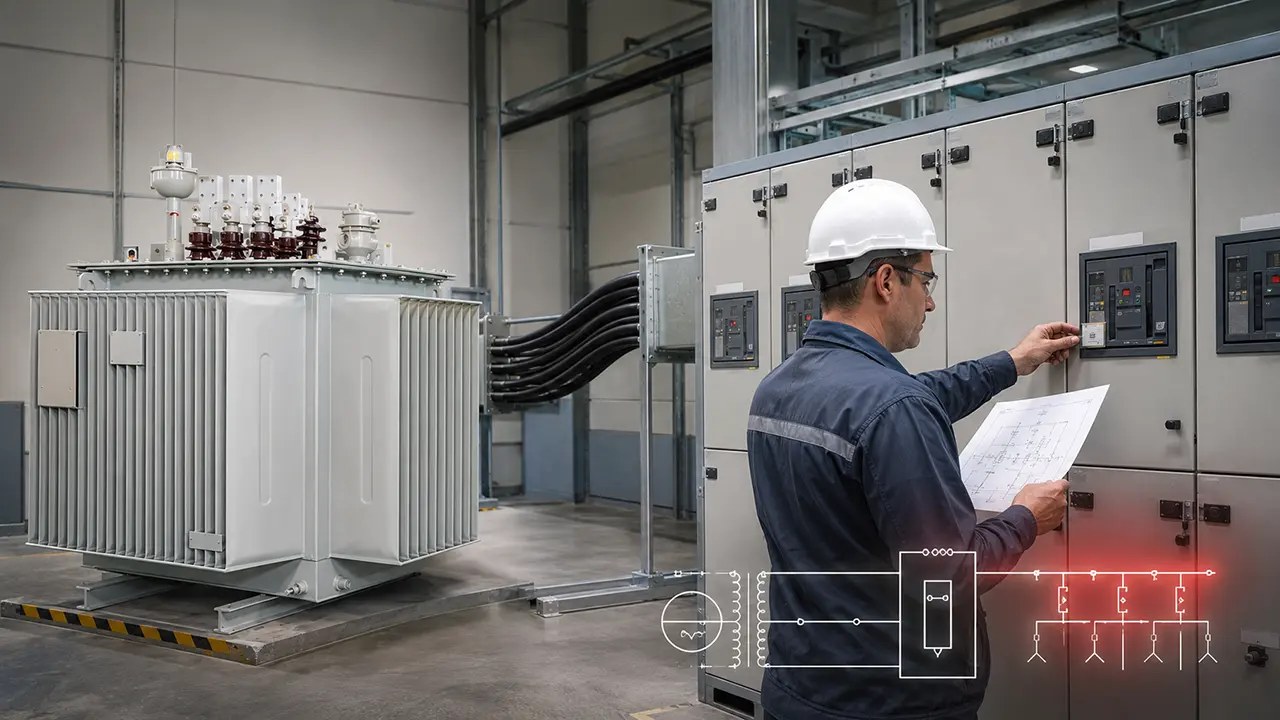
Transformer Short-Circuit Current and Switchgear Rating: What Buyers Should Verify Before an Upgrade
A transformer upgrade can solve one problem and create another if the downstream system is not checked carefully. A factory may replace a 1600 kVA transformer with a 2500 kVA unit to support expansion, or choose a lower-impedance transformer to improve voltage performance. The new transformer may be technically correct by itself, but the available short-circuit current at the low-voltage bus can increase enough to exceed the rating of existing switchgear, busbars, cables, breakers, or protection devices.
For procurement teams, this is a common blind spot. The purchase discussion often focuses on capacity, losses, delivery time, and price. Short-circuit current is treated as an engineering detail until the EPC contractor, utility, or commissioning team asks whether the existing low-voltage panel can safely withstand the new fault level.
The safer approach is to evaluate transformer short-circuit current before the purchase order is released, especially when a project involves capacity expansion, parallel operation, transformer replacement, or a change in impedance.
Why short-circuit current changes after a transformer upgrade
Short-circuit current is the current that can flow during a fault, such as a phase-to-phase or phase-to-earth fault. In a simplified view, it depends on the transformer capacity, transformer impedance, upstream supply strength, cable impedance, motor contribution, and the location of the fault.
When transformer capacity increases, the available fault current can rise. When transformer impedance decreases, fault current can also rise. When two transformers operate in parallel, the fault current at the common bus may increase significantly because both units can feed the fault.
This creates a practical trade-off. A transformer with lower impedance may support better voltage stiffness during motor starting, but it can require stronger downstream equipment. A higher-impedance unit may limit fault current, but it may worsen voltage dip under heavy starting conditions. For factories with large motors, the decision should be coordinated with starting performance. Our guide on transformer impedance and motor starting voltage dip explains the voltage side of the same trade-off.
The switchgear rating is not automatically protected by the transformer nameplate
A frequent misunderstanding is that if the transformer is new, tested, and compliant, the downstream switchgear must also be safe. That is not true. The transformer and the switchgear are different pieces of the same electrical system, and each must be suitable for the fault conditions it may experience.
A transformer supplier can provide the transformer impedance and other data needed for calculation, but the switchgear rating must be compared against the calculated fault current at its installation point. This check normally includes:
- rated short-time withstand current;
- rated peak withstand current;
- breaker interrupting capacity;
- busbar withstand rating;
- protection device coordination;
- cable thermal withstand under fault duration;
- earthing system and fault-clearing method.
The key question is not only “Can the transformer withstand a short circuit?” It is also “Can the downstream system safely interrupt and withstand the fault current made available by this transformer?”
Use standards as a framework, not as a substitute for project data
International standards provide the language and calculation framework, but they do not replace site-specific engineering. IEC 60909-0:2016 applies to short-circuit current calculation in low-voltage and high-voltage three-phase AC systems. IEC 60076-5:2006 addresses the ability of power transformers to withstand short-circuit conditions.
For a buyer, the practical lesson is straightforward: ask for the data that allows the consultant or panel supplier to calculate and verify the system. Do not rely only on a nominal kVA rating or a generic equipment catalog. The actual risk depends on the network arrangement, transformer impedance tolerance, cable lengths, motor loads, and protective device settings.
A simple example of why capacity changes matter
Consider a plant that currently operates with one 1600 kVA transformer feeding a low-voltage main switchboard. The switchboard was selected years ago for the fault level available at that time. The factory now wants to install a 2500 kVA transformer because production capacity is increasing.
The expansion may look simple: same primary voltage, same secondary voltage, same room, larger transformer. But if the new transformer has a larger kVA rating and similar or lower impedance, the prospective short-circuit current on the low-voltage bus may rise beyond the old switchboard rating.
If nobody checks this early, the project may face late-stage problems:
- the existing panel must be replaced after the transformer is already ordered;
- breaker models need to change, affecting delivery time;
- protection settings no longer coordinate correctly;
- the utility or inspection body asks for a short-circuit study before energization;
- the project loses the cost advantage expected from a simple transformer replacement.
The cost of the study is small compared with the cost of discovering an under-rated switchboard during installation.
Parallel transformers need special attention
Parallel operation is attractive for factories that need redundancy, staged expansion, or maintenance flexibility. However, it is one of the clearest cases where short-circuit current can be underestimated.
If two transformers feed the same low-voltage bus, a downstream fault may receive contribution from both transformers. Even when each transformer is individually within specification, the combined fault level may exceed the rating of the switchgear that was originally selected for a single transformer.
Before planning parallel operation, buyers should confirm:
- transformer voltage ratio, vector group, impedance, and tap position compatibility;
- low-voltage switchgear short-time and peak withstand ratings;
- breaker interrupting capacity at the common bus;
- bus coupler rating and interlocking logic;
- protection selectivity under single-transformer and parallel modes;
- operating procedures for maintenance, emergency transfer, and future expansion.
A second transformer should not be treated as a simple duplicate purchase. It changes the electrical behavior of the system.
Motor contribution can affect the fault study
Large motors do not only draw current during starting. During a nearby short circuit, rotating motors can temporarily feed current back into the fault. The effect may be short, but it can influence peak current and equipment duty in motor-heavy plants.
This is especially relevant in factories with compressors, chillers, pumps, fans, crushers, rolling equipment, or large process motors connected close to the main bus. If the plant also uses variable-frequency drives, soft starters, or motor control centers, the consultant should understand the actual configuration rather than assuming all loads behave the same way.
For procurement, the action item is simple: include major motor data in the transformer RFQ and switchgear review. A load list that only shows total kW may not be enough for a meaningful short-circuit study.
Information buyers should prepare before requesting a transformer quote
A stronger RFQ helps suppliers and engineering partners identify risk before it becomes expensive. For transformer replacement or expansion projects, buyers should prepare:
- existing transformer rating, voltage ratio, impedance, vector group, and tap range;
- proposed new transformer capacity and preferred impedance, if already known;
- existing switchgear rated short-time withstand current and breaker interrupting rating;
- single-line diagram showing transformer, main switchboard, bus coupler, and major feeders;
- cable lengths and sizes between transformer and switchgear;
- utility short-circuit data at the point of supply, if available;
- large motor ratings, starting methods, and normal operating arrangement;
- whether transformers will run separately, in parallel, or with automatic transfer;
- future expansion stages and reserved feeders;
- local code, utility, or EPC requirements for fault studies.
If the project uses an outdoor distribution yard or high-capacity industrial installation, an oil-immersed transformer may be evaluated for cooling capacity and lifecycle economics. If the transformer is installed indoors near production areas or commercial spaces, a dry-type transformer may be more suitable. In either case, the product category does not remove the need to verify downstream fault ratings.
Warning signs before placing the order
A short-circuit review should move to the front of the procurement process when any of the following conditions appear:
- the new transformer is larger than the existing unit;
- the quotation offers a noticeably lower impedance than the old transformer;
- two or more transformers may operate in parallel;
- existing switchgear is old or its rating plate is missing;
- the project reuses a low-voltage room designed for a smaller load;
- large motors are connected near the main bus;
- a bus coupler or automatic transfer system is being added;
- the local authority or utility requires a short-circuit calculation before energization;
- switchgear replacement is not included in the project budget.
These conditions do not automatically mean the project is unsafe. They mean the purchase should not proceed on transformer price and capacity alone.
A better upgrade decision protects both capacity and safety
Transformer replacement is often justified by growth: more production lines, larger refrigeration systems, new compressors, or higher utilization of existing equipment. But a good upgrade decision must protect more than load capacity. It must also protect people, equipment, and project schedule by confirming that the downstream electrical system can handle the new fault level.
For factory owners, EPC teams, and procurement managers, the best time to ask about transformer short-circuit current is before the transformer specification is frozen. Once the impedance, capacity, switchgear rating, and operating arrangement are reviewed together, the project team can choose a transformer that supports expansion without creating hidden risk at the low-voltage bus.
