
When Does a Factory Need an On-Load Tap-Changing Transformer?
A factory can have enough transformer capacity and still suffer from unstable production if voltage moves outside the operating window of its equipment. This is especially common in plants with large motors, welding lines, compressors, furnaces, variable production shifts, or a weak incoming utility network.
In these situations, the procurement question is not only “How many kVA do we need?” It becomes: “Can the transformer keep the secondary voltage stable while the plant is running?”
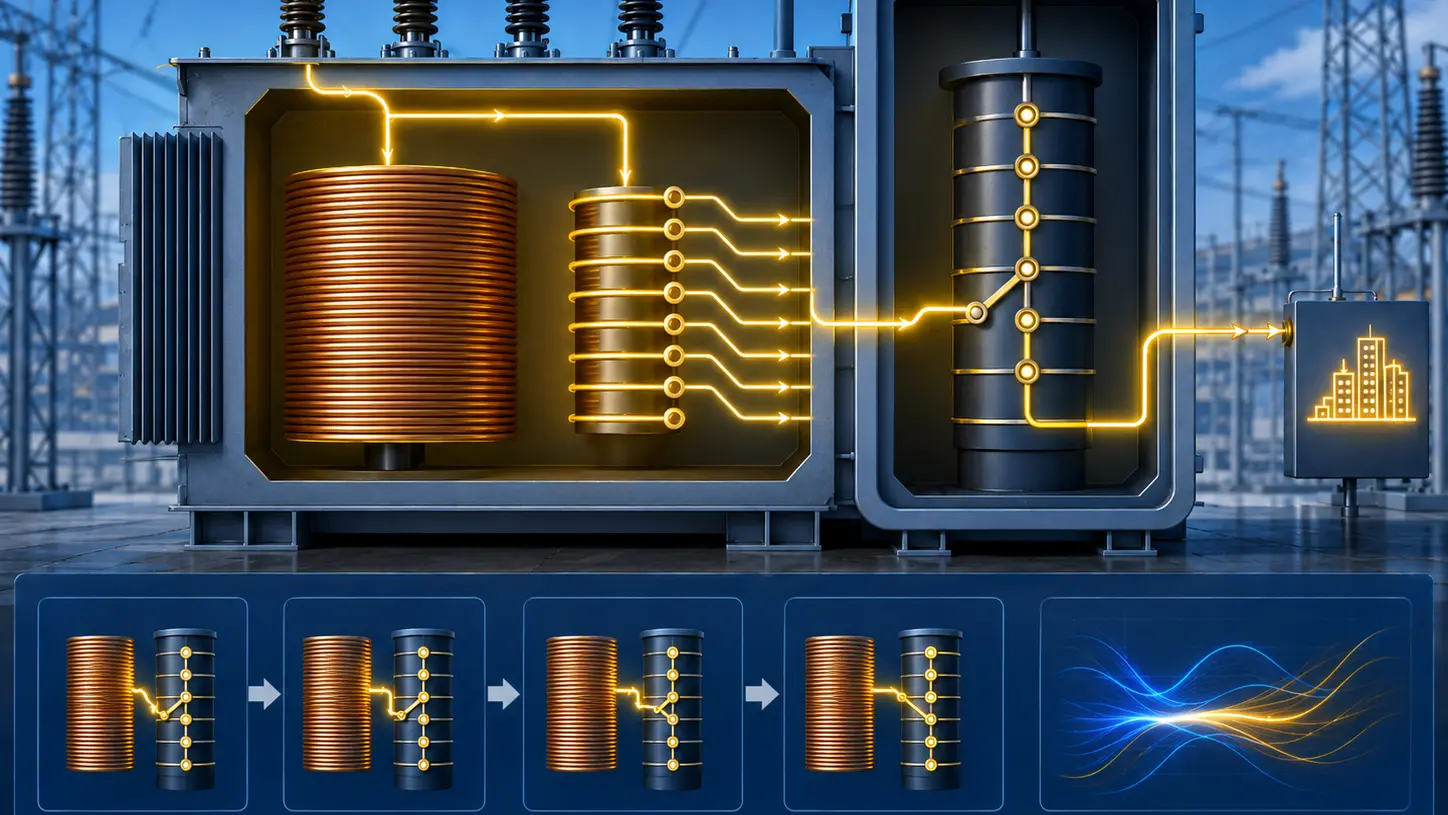
That is where an on-load tap-changing transformer may be worth evaluating. Unlike an off-circuit tap changer that requires the transformer to be de-energized before tap adjustment, an on-load tap changer allows voltage regulation while the transformer remains in service. For industrial users, the value is not the tap changer itself; the value is fewer voltage-related interruptions, fewer process complaints, and better control of delivered power quality.
The real trigger is voltage behavior, not factory size
Some teams assume an on-load tap-changing transformer is only for very large substations. In practice, the decision should start with measured voltage behavior and production sensitivity.
A medium-sized factory may need online voltage regulation if it is connected to a feeder with frequent voltage variation. A larger plant may not need it if the utility supply is stiff, load changes are gradual, and downstream equipment tolerates the normal voltage band.
The most useful early evidence includes:
- incoming voltage logs over working and non-working hours;
- voltage dips during motor starting or process restart;
- complaints from drives, PLCs, UPS systems, or quality-control equipment;
- seasonal voltage patterns during peak grid demand;
- planned expansion that will make load swings more severe.
Before specifying a solution, buyers should separate three issues: insufficient capacity, poor power factor or harmonic conditions, and upstream voltage fluctuation. An on-load tap changer helps with sustained voltage deviation and controlled regulation, but it is not a universal cure for every power-quality problem.
When off-circuit tap adjustment is usually enough
Many distribution transformers are supplied with off-circuit tap positions. This is a practical and economical choice when the site voltage is generally stable and adjustment is needed only during commissioning or after a long-term system change.
Off-circuit taps are often sufficient when:
- the utility voltage remains within a narrow range;
- production load changes slowly and predictably;
- the plant can accept a planned shutdown for tap adjustment;
- sensitive equipment already has local voltage control or UPS support;
- the transformer is serving a relatively steady auxiliary load.
For these projects, adding an on-load tap changer may increase cost, complexity, maintenance requirements, and failure points without creating meaningful operational value.
When an on-load tap changer becomes practical
An on-load tap-changing transformer becomes more reasonable when voltage instability is both frequent and operationally expensive. The clearest cases are not theoretical; they show up as repeated production symptoms.
1. Utility-side voltage varies during the day
Factories located at the end of a feeder, in developing industrial zones, or near other heavy loads may see incoming voltage change with grid demand. If the low-voltage bus drifts too high during light load and too low during production peaks, fixed tap settings become a compromise.
Online tap changing allows the transformer to follow a target secondary voltage band instead of leaving the plant to absorb every upstream movement.
2. Production loads change sharply by process stage
Batch plants, metal processing facilities, cold-storage sites, and plants with large compressors often move between low-load and high-load states quickly. If the voltage profile changes enough to affect equipment operation, online regulation can help stabilize the bus during normal production transitions.
This point connects closely with transformer sizing. A transformer that is correctly sized for a variable-load factory still needs to be evaluated for voltage performance under realistic operating profiles, not only under a static connected-load total. For a broader capacity-planning framework, see our guide on sizing a distribution transformer for a factory with variable loads.
3. Process equipment is sensitive to voltage deviation
Some production environments tolerate small voltage movement without issue. Others do not. CNC machines, precision testing systems, automated packaging lines, data acquisition equipment, medical manufacturing lines, and some drive-based processes may respond badly to voltage deviation even when the transformer is not overloaded.
In these projects, the economic case for online voltage regulation may come from avoided scrap, fewer nuisance trips, and more predictable process control rather than from transformer efficiency alone.
4. Future expansion will increase voltage fluctuation
A factory may operate acceptably today but have a second phase already planned. If expansion will add large motors, heat-treatment equipment, refrigeration, or other cyclic loads, it is risky to evaluate tap-changing needs only against the first-phase load list.
The better question is: after expansion, will the plant still be able to hold the required voltage band without frequent manual intervention?
What buyers should specify before requesting a quote
A useful RFQ for an on-load tap-changing transformer should do more than list capacity and voltage ratio. It should describe how the transformer will be expected to regulate under real conditions.
Key information includes:
- rated capacity and primary/secondary voltage;
- expected voltage variation on the incoming side;
- required secondary voltage target or allowable band;
- tap range and step preference, if already defined by the consultant;
- load profile by shift, season, and major process stage;
- maximum motor starting or restart condition;
- harmonic sources such as VFDs, rectifiers, or furnaces;
- installation environment and cooling arrangement;
- required accessories, protection devices, and control interface.
The international transformer standard series IEC 60076 treats transformer specification as a functional engineering matter, including topics such as harmonic content, transport, safety, environmental requirements, and condition monitoring. For buyers, the practical lesson is simple: an OLTC decision should be made from system duty and site conditions, not from a model name alone.
Maintenance and control discipline cannot be ignored
An on-load tap changer is a moving electrical-mechanical component. It brings operational flexibility, but it also requires suitable maintenance planning.
Before approving the specification, factory teams should confirm:
- who will inspect tap-changer operation after commissioning;
- whether tap position, operation count, alarms, and control status will be monitored;
- how local and remote control modes will be managed;
- what spare parts and service response are available;
- whether maintenance intervals match the expected switching duty.
A plant with unstable voltage but weak maintenance discipline may still experience reliability problems if the tap changer is treated as a “fit and forget” accessory. The best results come when regulation performance, protection settings, and inspection routines are considered together.
Procurement mistakes that increase risk
Several common mistakes appear in cross-border industrial projects.
The first is requesting an OLTC transformer only because it sounds more advanced. If voltage records do not support the need, the buyer may pay for unnecessary complexity.
The second is choosing the cheapest OLTC option without checking switching duty, control logic, service access, and compatibility with the site’s protection system.
The third is ignoring the downstream network. If voltage complaints are caused mainly by undersized cables, poor reactive power compensation, severe harmonics, or uncoordinated motor starting, the transformer alone cannot solve the full problem.
The fourth is failing to define the acceptance criteria. During commissioning, both buyer and supplier should know what secondary voltage band is expected, under which load condition it will be checked, and how tap control will be verified.
A practical decision checklist
For many industrial buyers, the decision becomes clearer with five questions:
- Is voltage variation measured, repeated, and operationally harmful?
- Can the issue be solved more simply through fixed tap adjustment, cable correction, compensation, or load sequencing?
- Does production require voltage regulation without planned shutdown?
- Will future expansion make the voltage profile less stable?
- Can the site maintain and monitor the tap changer properly over its service life?
If the answer to most of these questions is yes, an on-load tap-changing oil-immersed transformer deserves serious evaluation. If only one condition applies, the project may need a broader power-quality review before selecting the transformer configuration.
The best OLTC decision is evidence-based
An on-load tap-changing transformer is not a premium label to add automatically. It is an engineering tool for a specific operating problem: maintaining usable voltage while the electrical system and production load continue to change.
For factory owners, EPC teams, and procurement managers, the strongest decision comes from combining site voltage data, load behavior, equipment sensitivity, expansion plans, and maintenance capability. When these facts point in the same direction, online voltage regulation can become a reliable part of the plant’s power-distribution strategy rather than an expensive accessory.
