
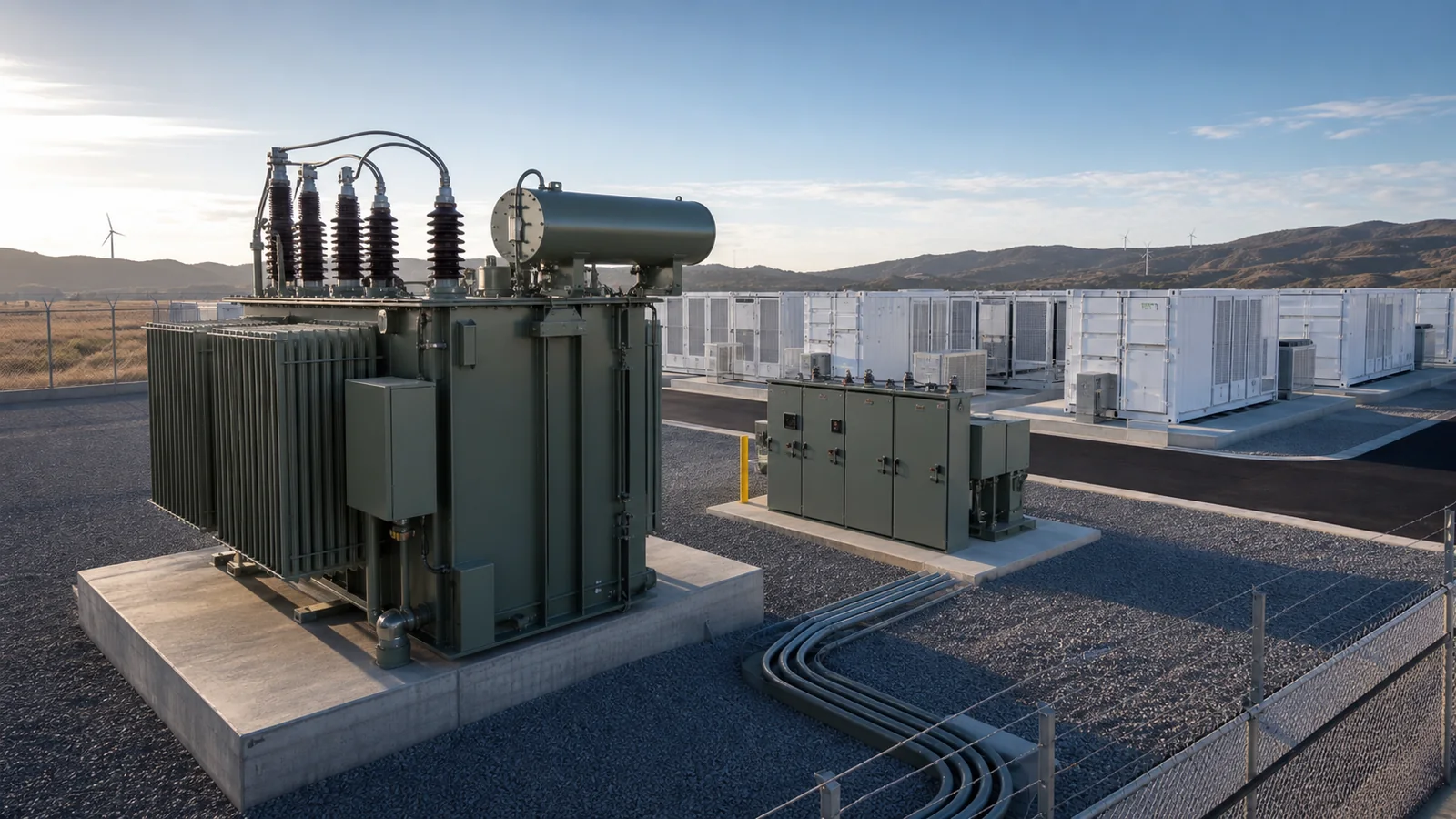
BESS Transformer RFQ: Interface Checks Before Ordering
A battery energy storage system (BESS) transformer should be quoted from an approved AC interface, not from MW/MWh figures alone. The useful procurement package connects the power-conversion system (PCS), transformer, medium-voltage collection equipment, auxiliary supply, controls, and grid connection documents. That makes it possible for bidders to state what they have assumed and for the project team to find the missing engineering decisions before manufacture starts.
This article is for developers, EPCs, industrial owners, and utilities procuring a transformer or compact substation for a BESS project. It does not select a transformer rating, vector group, impedance, protection setting, grounding method, or grid-forming function. Those choices must be confirmed by the project single-line diagram, interconnection agreement, inverter/PCS documentation, applicable market rules, the final supplier datasheet and test records, and qualified electrical engineers.
Start with the AC block boundary
The term “BESS transformer” can describe different equipment boundaries. A project may have individual inverter blocks, a shared step-up transformer, a packaged MV station, or a transformer supplied separately from the PCS and switchgear. The transformer may see power flowing from the grid toward the batteries while charging and from the batteries toward the grid while discharging. That operating fact does not, by itself, specify the transformer; it does mean the RFQ must identify the intended AC operating modes and who validates their system effects.
Before asking for a quotation, issue the controlled single-line diagram and a simple boundary drawing. Mark the transformer terminals, PCS AC terminals, MV cable or bus route, MV switchgear, point of connection, meter/CT/VT boundaries, auxiliary source, communication handoff, and earthing interfaces. If a document is preliminary, label it as preliminary. A supplier can then quote against an explicit assumption rather than silently using a familiar solar or industrial arrangement.
The utility-connection RFQ guide is a useful companion where a network operator controls the connection data. For packaged equipment, the compact-substation interface checklist helps separate transformer, enclosure, switchgear, civil, and site-work scope.
BESS transformer RFQ matrix
Use this matrix to make offers comparable. It is an information schedule, not a universal design standard.
| RFQ item | What the buyer should provide or request | Why it matters |
|---|---|---|
| Project AC basis | Provide the latest single-line diagram, nominal voltages, frequency, point of connection, declared import/export arrangement, and the source/revision for each value. | MW/MWh alone does not show the transformer terminals or the voltage boundary that equipment must meet. |
| PCS and operating modes | Attach the PCS/inverter AC data, number of blocks, intended charging/discharging duty, reactive-power or voltage-control obligations if defined, grid-following or grid-forming requirement if specified, and known operating restrictions. | The transformer supplier needs the project operating statement; a model name or a generic “bidirectional” note is not enough. |
| Transformer electrical interface | State the required ratio, tap requirement, winding connection/vector group, neutral availability, insulation and impedance requirements only where confirmed by project documents. Ask bidders to list every assumption and departure. | Phase shift, neutral treatment, cable interface, protection and parallel-operation implications cannot be settled from a typical BESS layout. |
| Waveform and study inputs | Provide the PCS harmonic data or the study inputs available to the project, expected filters/reactors, point of evaluation, loading profile, and any utility power-quality requirement. | Inverter current characteristics and system impedance can affect transformer loading and the wider AC system. A dedicated study may be required. |
| MV collection and protection boundary | Identify the included MV switchgear, breakers, CTs/VTs, relays, surge protection, interlocks, cable terminations, relay-setting owner, and utility interfaces. | A transformer quotation should not imply that protection coordination, cable design, or interconnection approval has been completed. |
| Auxiliary and controls | State the required auxiliary voltage/source, cooling or monitoring auxiliaries where applicable, alarm/trip point list, marshalling terminals, SCADA/BMS handoff, cyber/communications responsibility, and loss-of-auxiliary behavior required by the project. | A transformer can be mechanically complete yet not be usable if its controls and auxiliary source have no defined owner or interface. |
| Physical and environmental boundary | Provide site layout, indoor/outdoor location, ambient and altitude data where specified, access, cable entry, containment/fire requirements where applicable, and the relevant civil drawing. | Equipment arrangement, cooling, access, containment and local safety measures are project-specific, not default transformer features. |
| Evidence and release | Request a controlled data sheet, outline/interface drawing, terminal and point lists, applicable factory-test records, packing information, document language, and a deviation register. | The team needs evidence that the quoted transformer is the one shown in the accepted BESS interface documents. |
Separate power conversion from transformer assumptions
It is tempting to send the transformer supplier only the PCS rated power and its AC voltage. That can produce a budgetary indication, but it is not a release-quality basis. The project should identify whether values come from a PCS datasheet, a grid study, a utility offer, an owner specification, or a preliminary layout. When a requirement is not yet fixed, ask the bidder to show the option, technical consequence, commercial effect, and required decision date.
Pay particular attention to phase displacement and neutral treatment. A transformer winding connection may affect the AC-side interface, metering, protection, harmonic paths, and any connection beside existing equipment. The transformer vector-group RFQ checklist explains why this is a system decision rather than a catalogue default. Earthing and protection coordination likewise require the project engineer, utility, and applicable local rules to confirm the final design.
For the waveform question, avoid a loose request for a “harmonic-ready” transformer. Attach the data the project actually has: PCS current spectrum or study model where available, filters or reactors, expected simultaneous blocks, duty profile, and the point at which any limit is evaluated. The harmonic-loads RFQ guide gives a disciplined way to record those inputs. It does not replace a power-quality, resonance, protection, or thermal study.
Do not make the transformer responsible for plant-level grid performance
Interconnection requirements can cover functions such as voltage and frequency response, reactive-power control, protection, models, testing, and communications. Which functions apply depends on the connection voltage, market, utility or system operator, BESS/PCS configuration, and project agreement. The transformer is one interface within that plant-level arrangement; it does not prove that an inverter or the overall BESS meets a grid requirement.
IEEE 2800-2022 establishes interconnection and interoperability requirements for inverter-based resources connected to associated transmission and sub-transmission systems within its stated scope. The U.S. Department of Energy’s interconnection resources also point to different frameworks used for storage and inverter-based resources. These are not globally interchangeable procurement rules. The applicable utility documents, local code, project specification, and approval process decide what must be demonstrated for a particular site.
Where the transformer is part of a BESS block or a switchgear package, name one party to maintain the interface register. That register should show, for each boundary, the controlling drawing revision, input owner, supplier deliverable, approver, status, and needed-by date. It is much more useful than trying to make one data sheet carry every grid, PCS, transformer, and site obligation.
RFQ clauses buyers can adapt
The bidder shall quote against the attached BESS AC single-line diagram and interface register. The quotation shall state the offered transformer ratio, winding connection/vector group, tap arrangement, cooling and auxiliary assumptions, terminal configuration, outline, shipping condition, included accessories, applicable standard basis, documents, tests, and all exclusions or deviations. Values not fixed by the purchaser’s controlled documents shall be identified as assumptions or options.
The purchaser/EPC shall provide available PCS/inverter AC data, intended import/export operating statement, project load and harmonic-study inputs where available, point-of-connection and utility information, MV switchgear and cable interface data, auxiliary/control requirements, site conditions, and the approval route. Transformer selection, grounding, protection coordination, harmonic and resonance assessment, interconnection performance, civil/fire design, installation, site testing, and energization remain subject to qualified engineering review and applicable requirements.
Before manufacture release, the parties shall reconcile the accepted transformer data sheet, PCS interface, MV switchgear and cable drawings, auxiliary/control point lists, approved layout, document register, and accepted deviations. Unresolved interfaces shall have a named owner and a hold point.
A practical release rule
Do not release a BESS transformer order when the project can state only energy capacity, PCS MW, and an assumed MV voltage. Release it when the AC block boundary is controlled: the transformer terminals and operating statement are clear, the PCS and utility inputs are traceable, electrical and physical interfaces are assigned, and all remaining decisions have an owner and a required confirmation path.
That discipline does not slow a viable project. It prevents a normal transformer quotation from being mistaken for a complete decision on grid interconnection, inverter behavior, protection, or site acceptance.
