
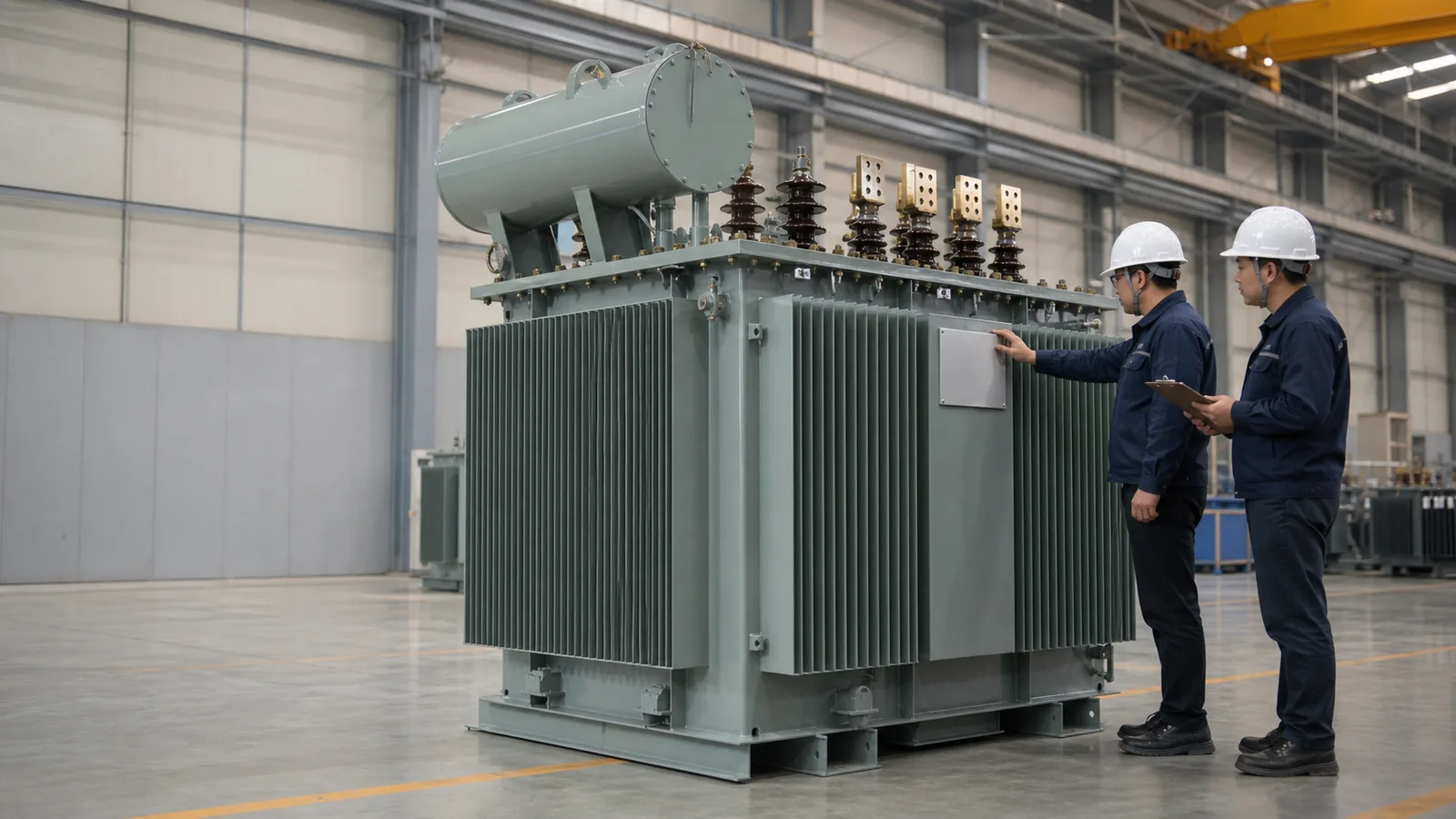
Transformer Nameplate Review Before Shipment: Buyer Checklist
A transformer nameplate is not a substitute for the approved data sheet, drawings or test report. It is the last compact statement that follows the equipment to the factory floor, shipping documents and site. Before shipment release, buyers should compare it line by line with the approved project basis. A mismatch caught while the unit is still accessible is usually easier to resolve than one found after installation, cable termination or energization planning has started.
This review is useful for oil-immersed and dry-type transformers, as well as transformer packages feeding MV or LV switchgear. It does not establish protection settings, grounding design, short-circuit duty, thermal capability or regulatory compliance. Those matters remain subject to the final project documents, applicable standard edition, utility requirements, local code, supplier documentation and qualified engineering review.
Start with the approved baseline, not the purchase-order title
The purchase-order description may say only “1,000 kVA, 11/0.4 kV transformer.” That is not enough to verify what is being released. Assemble the latest approved data sheet, single-line diagram, transformer outline drawing, terminal/cable-box drawing, deviation register and test/document schedule. Record their revision numbers beside the nameplate review.
Where the project uses an IEC basis, IEC 60076-1 describes the general scope for power transformers, including functional specification and transport-related topics within its stated scope. For continued-service maintenance testing in the North American context, ANSI/NETA MTS describes inspection and testing specifications within its own scope. These references do not turn a nameplate into a universal acceptance criterion: the applicable market and project specification decide the final requirement.
Buyer nameplate cross-check matrix
| Nameplate field | Compare it with | Why it matters | Stop and clarify if |
|---|---|---|---|
| Manufacturer identity, serial number, tag and quantity | Approved equipment schedule, purchase order and packing list | Links the physical unit to drawings, reports, spares and site records. | The tag, serial number or unit quantity cannot be traced to the project record. |
| Rated power and cooling designation | Approved data sheet and duty/cooling basis | A rating without its stated cooling basis can be misread by operations or procurement. | The rating or cooling notation differs, is incomplete, or is presented on a different basis. See the cooling-method RFQ guide. |
| HV/LV rated voltages, frequency and tap data | Single-line diagram, approved data sheet and tap schedule | These fields must align with the intended system and the selected tap arrangement. | A voltage, frequency, tap range, tap position reference or tap-changer type is absent or different. For an OLTC application, review the on-load tap-changing decision guide. |
| Connection symbol / vector group and neutral information | Approved single-line diagram and protection/earthing interface documents | Phase displacement and available neutral interface affect the way the transformer connects to the system. | The connection marking does not match the approved basis or neutral assumptions are unclear; use the vector-group checklist as a cross-check. |
| Impedance or other stated electrical characteristics | Approved data sheet and system-study assumptions | A declared value must be on the same stated basis as the approved technical requirement. | The field differs, has no stated tolerance/basis where one is required, or an unapproved deviation is implied. |
| Insulation, temperature or ambient statements, where specified | Project specification and approved technical schedule | These markings should not be interpreted outside their stated standard and condition. | The entry conflicts with the approved document, is unlabeled, or is being used to claim suitability for a different site condition. |
| Mass, liquid quantity or transport-related marking, where present | Outline drawing, shipping configuration and lifting plan | Site teams need the correct configuration before unloading and positioning. | The values cannot be tied to the supplied configuration or lifting/handling documents. |
| Standard reference and year, where shown | Contract standard list and deviation register | A standard number alone does not prove every option, test or local requirement. | The cited basis is different from the contract, lacks an agreed edition, or is being treated as global compliance. |
Do not “correct” a discrepancy by annotating a photograph or accepting a verbal confirmation. Ask for a controlled response: the approved document revision, the specific nameplate field, the proposed correction or explanation, and any impact on test records, drawings, labels, packing documents or installation work.
Read the rating together with its conditions
Nameplate data is concise by design. A value is only comparable when its associated conditions are understood. For example, a kVA rating should be read with the cooling designation; a voltage ratio with the tap reference; and a stated impedance with the agreed basis. A field that looks familiar may still be wrong for the project if it belongs to another unit, revision or operating condition.
This is particularly important when several similar transformers are ordered. Each physical unit needs its own tag-to-serial-number mapping, even if the ratings appear identical. The review should also identify whether the plate belongs to the final shipping configuration or a preliminary manufacturing record.
The nameplate does not replace the evidence behind it. Routine test reports, approved drawings and the agreed document register remain the source for detailed values and acceptance evidence. Before release, connect the nameplate record to the factory acceptance and shipment checklist rather than treating the plate photograph as the complete handover package.
Use a controlled review record
Ask the supplier for a clear, readable nameplate photograph or approved draft before final fixing where the project process allows it. Save it under the equipment tag, not in a generic email folder. The reviewer should mark each field as “matches,” “different,” “not shown,” or “not applicable,” and name the source document used for comparison.
A compact review record can include:
- Equipment tag, serial number, order line and photo date.
- Source-document numbers and revisions.
- Each nameplate field, stated value and comparison result.
- Open discrepancy number, responsible party and required close-out evidence.
- Release decision and reviewer date.
This record is not bureaucratic padding. It keeps a late label correction from being lost between factory inspection, freight forwarding and site receiving. At arrival, the same tag and serial number should be checked again alongside the receiving and temporary-storage checklist.
Common review traps
Treating a generic model reference as the project identity
A model or series designation may describe a family, not the approved project configuration. The project tag, serial number, rating, voltage/tap data and connection details are what make the unit traceable. If the nameplate does not provide the agreed identity fields, ask the responsible party how site asset records and test reports will be linked.
Assuming a standard citation settles every technical question
IEC, IEEE, ANSI or another standard reference can be useful context, but it does not automatically demonstrate the chosen options, test scope, efficiency rule, utility approval or local installation requirement. Confirm the edition and application in the project documents. For insulation terminology and its evidence boundary, see the insulation-level RFQ guide.
Letting a corrected plate drift away from the paperwork
If a plate must be replaced or corrected, request the updated photograph and check whether the test report cover, packing list, shipping marks, quality record and final data sheet also need revision. The objective is one consistent equipment identity, not merely a cleaner label.
Release rule: reconcile, document, then ship
Release a transformer only when the nameplate is traceable to the approved project basis and every material difference is either corrected or formally accepted by the responsible project authority. If an open item affects system connection, taps, terminal interface, protection, transport, lifting, testing or site records, pause release until the project team decides how to close it.
The final check should be proportionate to the project. It helps procurement and site teams catch documentation and identity errors; it does not replace electrical design approval, factory acceptance decisions, site testing or authorization to energize.
