
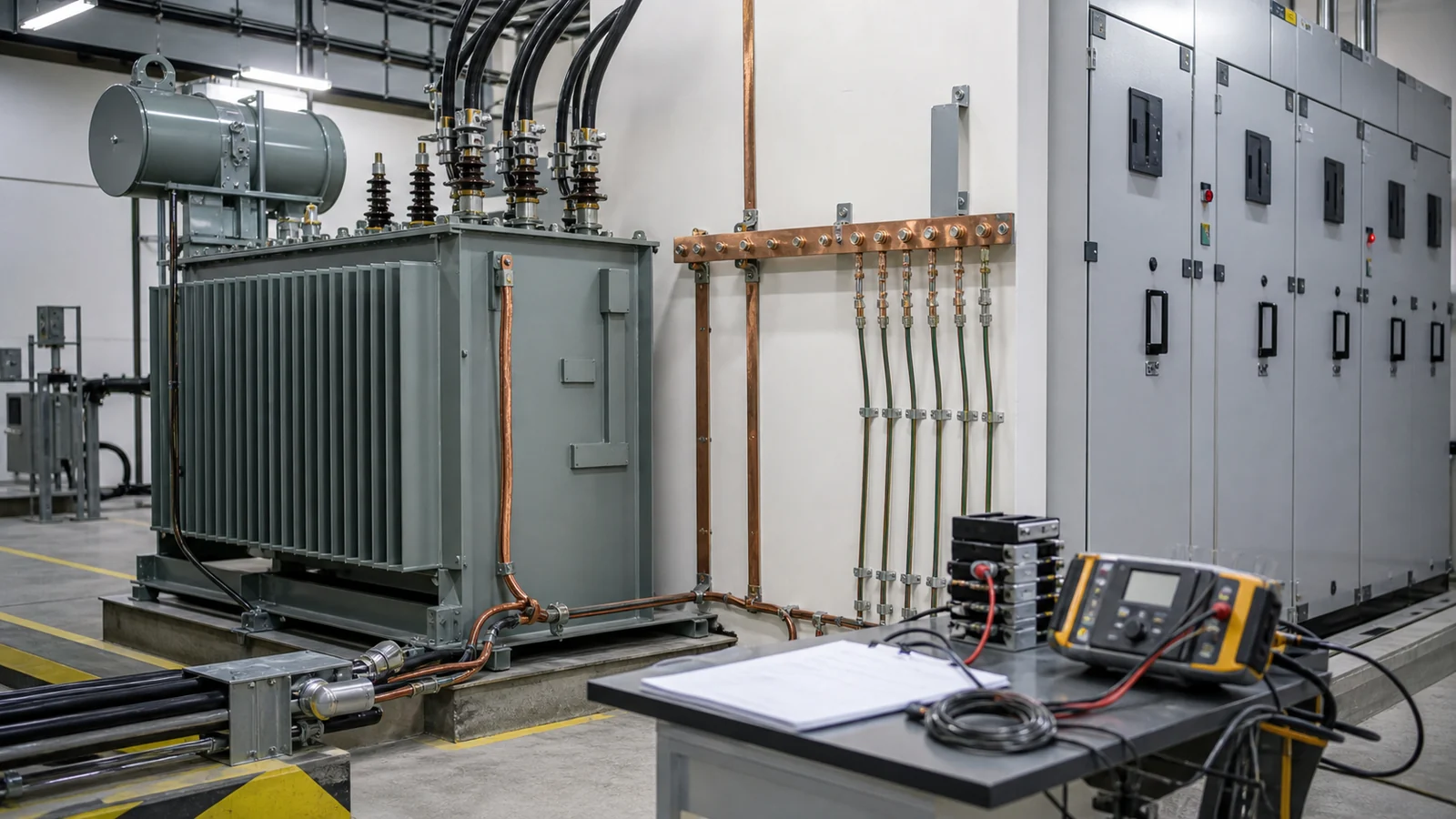
Transformer Neutral Grounding: RFQ Interface Checklist
A transformer RFQ should not stop at “grounded neutral.” The buyer should define the system earthing basis, transformer winding connection and vector group, neutral terminal requirements, grounding device scope if any, switchgear earth-bar interface, protection and metering requirements, documents, and the party responsible for final approval.
This article helps buyers, EPC teams, industrial plants, commercial buildings, utilities, mines, and renewable-energy projects prepare clearer transformer and switchgear RFQs. It does not design the grounding system. Neutral grounding, protection, insulation coordination, short-circuit duty, fire rules, and energization approval must be confirmed by the project engineer, local code, utility, AHJ, supplier documents, final datasheet, and test reports.
Neutral grounding is an interface, not a catalog option
The transformer is only one part of the earthing system. A neutral point may be solidly grounded, impedance grounded, connected through a neutral grounding resistor or reactor, connected through a grounding transformer, or handled in another way defined by the project. Some systems also need a clearly isolated neutral, special ground-fault detection, or coordination with generators, UPS systems, photovoltaic inverters, or utility metering.
That is why procurement teams should not ask suppliers to “choose the grounding.” The RFQ should state what the project design requires and ask the supplier to confirm whether the quoted transformer package can provide the required terminal arrangement, insulation basis, accessories, enclosure interfaces, and documents. If the project design is not complete, the RFQ should mark neutral grounding as an open engineering item instead of turning an assumption into an order.
This is especially important when a transformer is purchased separately from the switchgear. The transformer supplier may focus on winding connection and neutral bushing details, while the switchgear supplier may focus on CTs, relays, earth bars, cable compartments, interlocks, and trip circuits. Both packages must match the same system design.
RFQ matrix for neutral and earthing interfaces
Use the matrix below to collect the information that the engineer, utility, AHJ, and suppliers need before manufacturing is frozen. It does not define the correct grounding method.
| RFQ item | What to specify or ask | Why it affects the order |
|---|---|---|
| System earthing basis | State the required neutral earthing method, applicable market code, utility rule, project standard, and whether the transformer is part of an existing or new system. | The transformer terminal arrangement and switchgear protection cannot be reviewed without knowing how the system neutral is intended to behave during normal service and ground faults. |
| Winding connection and vector group | Confirm primary and secondary winding connection, vector group, phase displacement, neutral availability, and whether the equipment must match an existing transformer or switchboard. | The wrong vector group or unavailable neutral point can make the transformer unsuitable even when kVA and voltage ratio look correct. |
| Neutral terminal or bushing | Define whether the neutral must be brought out, its connection point, enclosure or tank interface, cable box details, insulation requirements, and nameplate marking. | A neutral terminal is a physical and documentation item, not just a schematic symbol. It affects layout, clearances, cable routing, and inspection. |
| Grounding device scope | If a neutral grounding resistor, reactor, grounding transformer, or ground-fault neutralizer is required, state whether it is supplied by the transformer vendor, switchgear vendor, EPC, or another party. | Grounding devices have their own ratings, duty, enclosure, protection, thermal, and testing requirements. They should not be hidden inside a generic transformer line item. |
| Switchgear interface | Confirm where the neutral conductor, earth conductor, cable shields, CTs, relays, meters, surge protection, and bonding points land in the MV or LV switchgear. | Many field problems appear at the transformer-to-switchgear boundary, especially when the two packages are bought from different suppliers. |
| Ground-fault protection | Provide the latest single-line diagram, protection philosophy, CT location, relay functions, trip or alarm logic, and setting responsibility. | The transformer quotation should not imply protection coordination. Settings and trip tests must be approved for the actual system. |
| Existing-site constraints | For replacement or expansion, provide existing transformer nameplate photos, vector group, neutral arrangement, earthing drawings, fault study, switchgear ratings, and operating history if available. | A new transformer can disturb an existing grounding and protection scheme even when capacity is unchanged. |
| Documents and tests | Request final datasheet, outline drawing, terminal diagram, nameplate data, factory test report, accessory schedule, grounding-device documents if applicable, and installation precautions. | The receiving, installation, and pre-energization teams need traceable documents before the equipment is connected to the live system. |
For upgrades, send this matrix together with the short-circuit current and switchgear rating checklist. Ground-fault behavior and three-phase fault duty are different questions, but both affect protection and equipment ratings.
When grounding changes the transformer package
Neutral grounding can change the physical transformer package. For an oil-immersed transformer, the project may need a neutral bushing, tank grounding points, surge arrester interfaces, cable boxes, marshalling terminals, oil containment details, or external grounding-device space. For a dry-type transformer, the review may focus on neutral bars, enclosure bonding, cable compartment access, temperature monitoring, room ventilation, and separation from other building systems.
A compact substation adds another layer because transformer, MV switching, LV distribution, enclosure, ventilation, cable entry, and earthing bars may be integrated before shipment. In that case, the RFQ should show how the neutral and earth conductors move through the complete package; a “standard” compact substation does not automatically resolve local utility grounding interfaces.
Grounding also affects drawings and inspection. Buyers should check terminal marking, conductor landing points, earth-bar continuity details, accessory wiring, and the final nameplate before shipment release. Continue the same items into the pre-energization checklist because factory documents do not prove site cable termination, bonding, relay settings, or authority approval.
Warning signs before releasing the order
Pause the order and ask for engineering clarification when any of these issues appear:
- the quotation says “standard grounding” but the project documents do not define the earthing method;
- the transformer vector group, neutral availability, or phase displacement is missing from the datasheet;
- a neutral grounding resistor, reactor, or grounding transformer is required but no party has accepted supply and testing scope;
- the switchgear CT location, relay function, trip logic, or alarm logic is not aligned with the transformer neutral arrangement;
- the project is a retrofit, but the existing earthing drawings, protection settings, and nameplate records have not been collected;
- the supplier is asked to confirm compliance with a market code without being told the installation country, utility rule, or AHJ requirement.
These issues can affect cable entry, enclosure size, accessory scope, protection settings, site testing, and energization approval.
Standards help name the issue, but the project decides
Standards and codes give project teams a common vocabulary. IEC 60076-1 is a common IEC reference for general power transformer requirements. IEEE C57.32 addresses neutral grounding devices in the IEEE context. In U.S.-based building and industrial installations, NFPA 70 is one example of a market-specific electrical-installation code that may be relevant when adopted by the local jurisdiction.
Those references do not create a universal answer. IEC, IEEE, ANSI, NEMA, GB/GB/T, NFPA, DOE, EU, utility, and local code language apply only when the target market and project specification require it. The RFQ should name the applicable basis instead of using “international standard” as a substitute for engineering review.
RFQ wording buyers can adapt
Buyers can add clauses like these to a transformer, compact substation, or switchgear RFQ:
“The quotation shall state the transformer winding connection, vector group, neutral terminal availability, terminal marking, grounding points, enclosure or tank interface, and any grounding-related accessories included in the quoted scope.”
“The project earthing method, ground-fault protection philosophy, utility requirements, local code, and AHJ review are subject to final project documents. Supplier shall identify assumptions and exclusions rather than selecting a grounding method without written project direction.”
“If a neutral grounding resistor, reactor, grounding transformer, ground-fault neutralizer, CT, relay, meter, or surge-protection interface is required, the quotation shall identify the responsible supplier, ratings to be confirmed, documents, factory tests if applicable, and site tests excluded from supplier scope.”
“Final acceptance and energization shall depend on approved drawings, final datasheet, supplier manuals, factory test report, site inspection, protection settings, grounding verification, local code, utility approval, and qualified engineering release.”
A practical decision rule
Do not release a transformer order until the neutral point, winding connection, earthing method, switchgear interface, protection responsibility, grounding-device scope, and approval path are written down.
That rule does not make the buyer the grounding designer. It simply prevents a transformer purchase from carrying an invisible assumption that the site team has to discover during installation or commissioning.
