
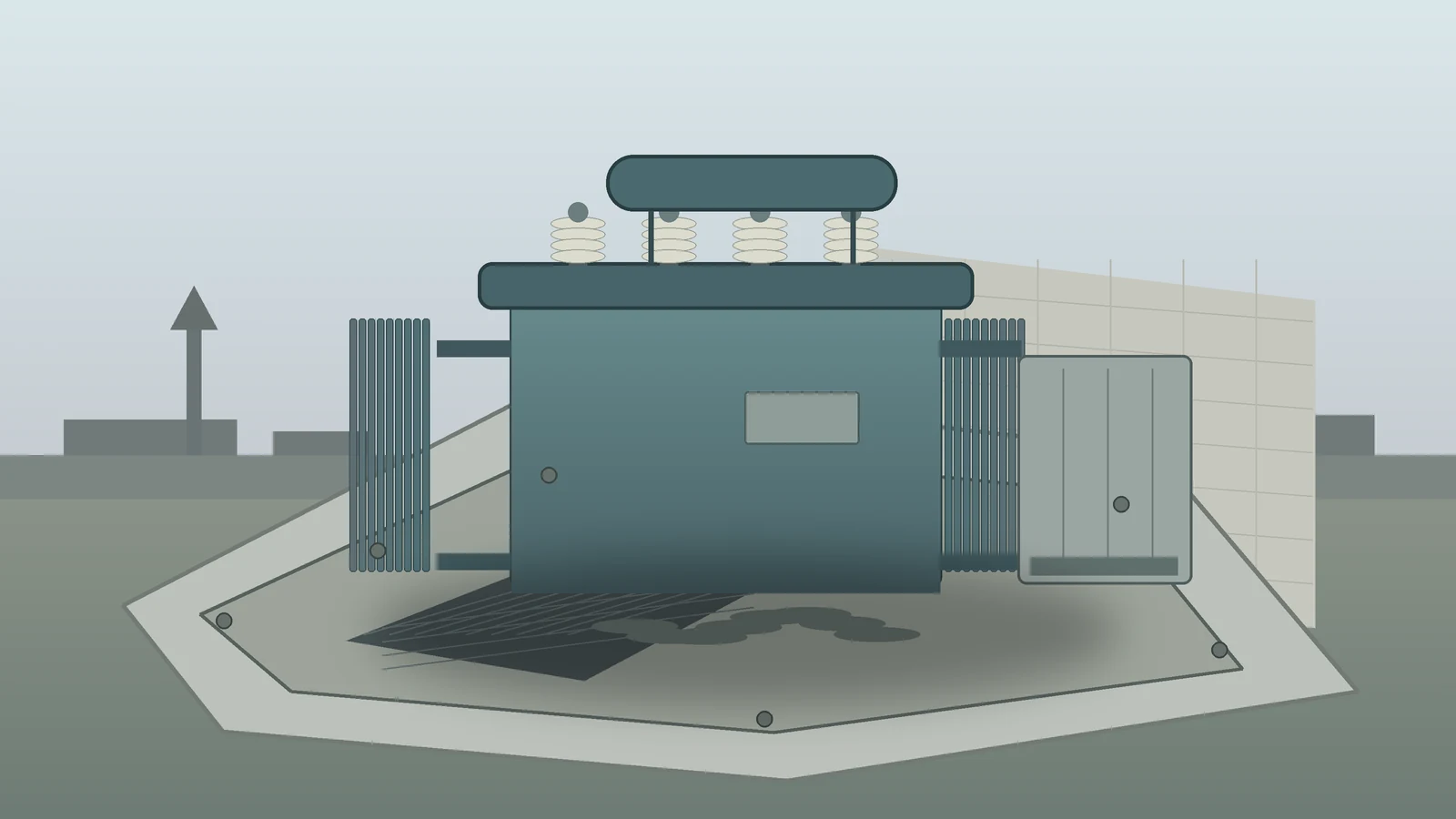
Transformer Oil Containment RFQ: Fire and Drainage Checks
An oil-filled transformer can have the right kVA rating, voltage ratio, impedance, and accessories while the project is still not ready to order it. The missing items are often outside the transformer tank: oil containment, drainage route, fire separation, access for inspection, environmental review, and who approves the final civil works.
The short answer is: an RFQ for an oil-filled transformer should define oil volume information, installation location, containment concept, drainage boundary, fire interface, access requirements, document deliverables, and the party responsible for final approval. The final solution still depends on project drawings, supplier datasheets, fire and environmental rules, utility requirements, local code, AHJ review, and qualified engineering design.
Use this article as a procurement checklist. It does not design a bund, oil pit, fire wall, extinguishing system, or spill response plan.
Why containment belongs in the transformer RFQ
Procurement teams often treat containment as a civil detail to be solved after the transformer is selected. That can work for early budgeting, but it is weak for a purchase order. An oil-immersed transformer may include radiators, valves, conservator or sealed-tank details, drain points, gauges, alarm contacts, cable boxes, wheels, and lifting points that all affect the space around the unit.
The transformer supplier may not be responsible for the concrete pit or drainage system. The EPC may not know the final oil quantity until the supplier’s datasheet is issued. The fire reviewer may need layout details before accepting the outdoor yard, indoor room, or compact substation arrangement. If those handovers are not defined, a buyer can receive a correct transformer quotation that still leaves an expensive site-interface problem.
RFQ matrix for oil containment, fire, and drainage
This matrix is not a universal standard. Adapt it to the market, project specification, utility process, civil design, and AHJ requirements.
| RFQ item | What to provide or request | Why it changes the order |
|---|---|---|
| Oil volume and boundaries | Request estimated and final insulating liquid quantity for the transformer, radiators, conservator if supplied, and any separate oil-filled accessory in the supplier scope. | Civil containment, transport handling, storage, environmental review, and emergency planning need traceable unit-specific data. |
| Installation arrangement | State whether the unit is outdoor, indoor, rooftop, basement, fenced yard, mine site, public-access area, or inside a compact substation. Provide layout and nearby equipment. | Fire separation, access, drainage, ventilation, enclosure, and security assumptions differ by location. |
| Containment concept | Identify whether the project expects a curbed pad, oil pit, bund, sump, oil-water separator, sealed floor, removable grating, or another approved method. | The transformer outline, wheels, jacking points, cable entry, and radiator clearance may need to fit the civil containment concept. |
| Drainage and storm water | Define where rainwater, wash water, leakage, firefighting runoff, and sump discharge may go, subject to environmental approval. | A direct drain can create environmental or AHJ objections; a closed pit can create flooding and maintenance issues if not designed. |
| Fire interface | Provide known fire walls, separation distances, building openings, cable trenches, combustible materials, access roads, and firefighting assumptions. | The transformer footprint cannot be checked honestly if fire barriers and access routes are still unknown. |
| Access and maintenance | Request access to gauges, valves, oil sampling points, breathers where used, pressure devices, temperature devices, marshalling boxes, and leak inspection paths. | A containment wall or enclosure can block normal inspection if the layout is not reviewed before manufacturing. |
| Documents and responsibility | Request outline drawing, liquid quantity, lifting/handling notes, accessory list, terminal list, manuals, packing list, and exclusions for civil/fire/environmental works. | Procurement needs to know which package supplies data, which package builds the site works, and who signs final acceptance. |
Oil quantity is not the same as containment design
Buyers should ask the transformer supplier for oil quantity data, but they should not ask the supplier to guess the legal containment requirement for every market. The supplier’s datasheet can support the civil and environmental design; it does not replace it.
For example, a project may need to consider transformer oil quantity, rainwater accumulation, firefighting water, sump operation, oil-water separation, valves, inspection intervals, and emergency procedures. The acceptable method may be different for a utility yard, industrial plant, mine, commercial basement, renewable-energy site, or port facility. Final capacity, materials, slope, drainage, and alarm requirements should be confirmed by the project civil engineer, fire engineer, environmental reviewer, utility, local authority, and supplier documents.
This is why “standard oil pit by others” is not enough for an RFQ. A better approach is to ask for unit data and state the intended site concept, while leaving final dimensions and compliance to approved project documents.
Fire and environmental rules are market-specific
Standards and regulations help buyers ask the right questions, but they do not create one global rule. IEC 61936-1 is one IEC reference used for power installations above low-voltage range where that framework applies. IEEE Std 979 is an IEEE guide for substation fire protection in projects that use that practice. For U.S. facilities, the EPA’s SPCC rule overview is a reminder that oil-filled electrical equipment may need environmental review depending on the facility and stored oil profile.
Those links are not interchangeable requirements. A project may instead be governed by local fire code, environmental permit conditions, utility standards, GB/GB/T documents, owner insurance rules, mining rules, seismic rules, or AHJ instructions. Do not assume that IEC, IEEE, NFPA, ANSI, NEMA, DOE, EU, GB/T, or utility language automatically applies outside its intended market.
Compact substations still need a containment boundary
A compact substation can make installation cleaner, but it does not remove the need to define oil and fire boundaries. If the transformer compartment contains an oil-filled transformer, the RFQ should say whether containment is inside the enclosure, under the foundation, provided by site civil works, or outside the supplier scope.
This should be coordinated with cable trench openings, ventilation paths, door swing, roof drainage, public access, utility metering, MV switching, LV switchgear, and maintenance clearance. The broader compact substation interface checklist is useful when the transformer, enclosure, and switchgear are purchased as one package. The site-condition RFQ checklist can also help describe flooding, corrosion, dust, humidity, and access conditions.
For projects already near energization, containment should reappear in the pre-energization checklist. A transformer should not be released for service until drainage, oil level, valves, leak inspection, fire access, grounding, protection, documents, and local approvals are closed under the project procedure.
RFQ wording buyers can adapt
“Please quote the oil-filled transformer based on the attached single-line diagram, site layout, civil concept, fire requirements, environmental requirements, and project specification. Identify all assumptions and exclusions related to oil containment, drainage, fire separation, spill control, and site works.”
“Provide estimated oil quantity for quotation and final liquid quantity on the approved datasheet. Include outline drawing, drain and valve locations, radiator arrangement, conservator or sealed-tank arrangement, accessories, terminal boxes, lifting points, wheel or skid details, and maintenance access requirements.”
“State whether oil containment, sump, oil-water separator, fire wall, fire detection or suppression, drainage valves, environmental permits, civil works, and AHJ approval are included, excluded, or by others.”
“Final containment, drainage, fire protection, environmental compliance, utility acceptance, and energization approval remain subject to project drawings, local code, AHJ review, supplier datasheet, test report, and qualified engineering sign-off.”
Warning signs before the order is frozen
Pause for clarification if any of these points are still open:
- the transformer is oil-filled, but the RFQ does not ask for final liquid quantity;
- the layout shows a transformer pad, but no oil pit, bund, sump, or drainage boundary is defined;
- rainwater and firefighting runoff have no approved discharge path;
- a compact substation is requested, but containment is not assigned to the supplier or civil scope;
- a fire wall, building opening, cable trench, or public road is near the transformer and has not been reviewed;
- the supplier quotation says “oil containment by others” without stating the data it will provide;
- the project crosses markets and assumes one standard family will satisfy another authority.
The practical rule is simple: do not treat oil containment as paperwork after the transformer purchase. Make the transformer supplier provide reliable unit data, make the RFQ name the civil and fire boundaries, and make the project authority approve the final arrangement before shipment, installation, and energization decisions depend on it.
