
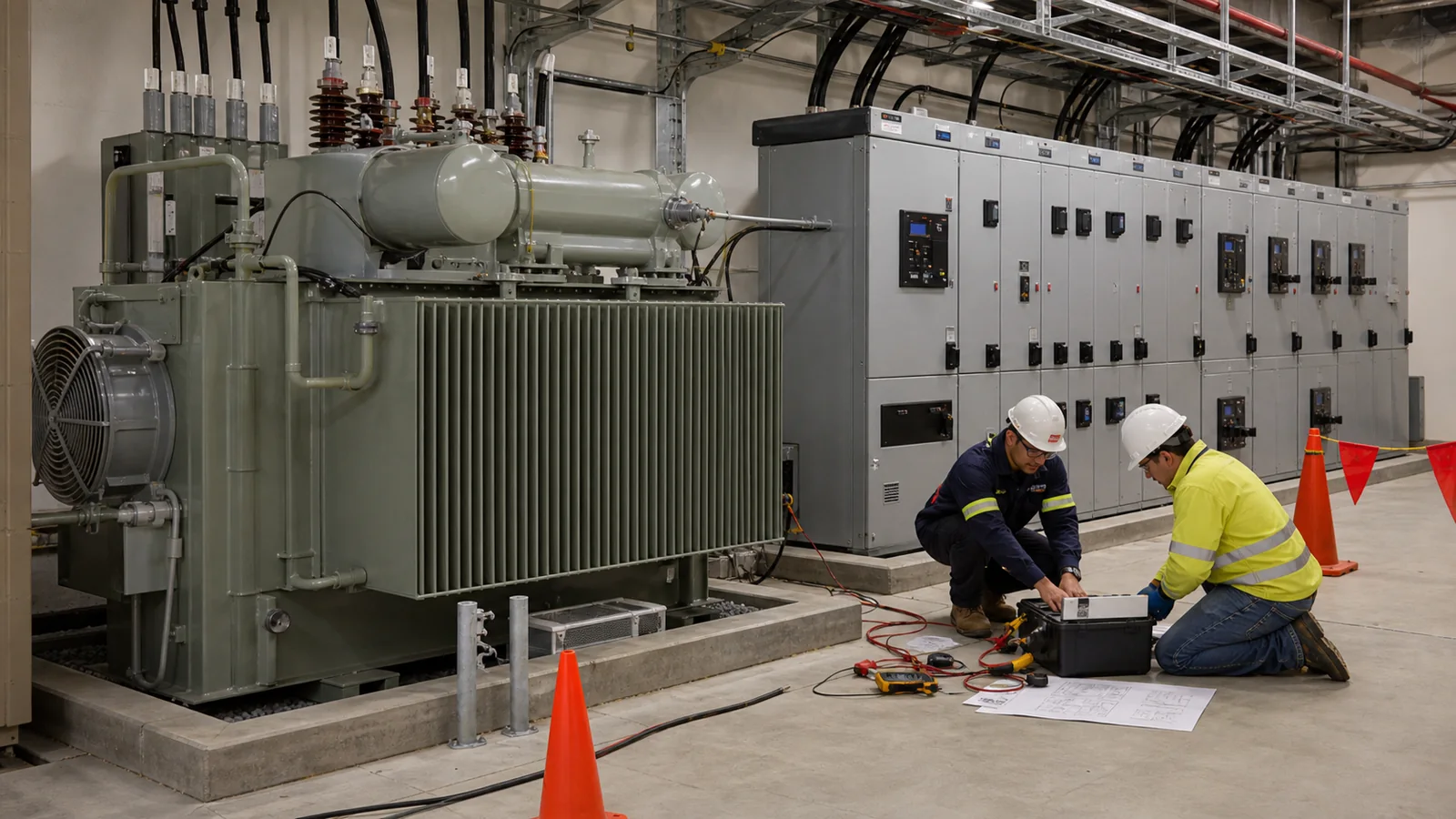
Transformer SCADA Interface: RFQ Checks Before Ordering
A transformer can arrive with all requested temperature devices and alarm contacts, yet still be invisible to the plant SCADA, BMS, or utility control system. The gap is usually not the transformer rating. It is an interface decision left open between the transformer supplier, switchgear supplier, system integrator, and owner.
The practical answer is to define the monitoring boundary before the purchase order is released: which conditions must be visible, whether signals are hardwired or communicated, where the boundary terminals or gateway sit, who supplies each cable and configuration, how points are named, and how the interface will be tested. The final design must be confirmed by the approved single-line diagram, control architecture, supplier drawings, cybersecurity requirements, project specification, local rules, utility requirements, and qualified engineering review. This guide is for clearer RFQs; it is not a protection design, SCADA design, cybersecurity assessment, or authorization to connect to an operating-control network.
Start with the operating decision, not a protocol name
It is tempting to write “Modbus required” and consider the job complete. That leaves critical questions unanswered. Is the request for a few remote alarm contacts, a meter, a transformer monitoring device, a switchgear relay, or a package gateway? Does the owner need indication only, event history, trend data, remote control, or all of these? Which system owns the final point list?
Before comparing offers, record the expected operating action for every requested item: indication, maintenance alert, alarm, trip, interlock, trend, or remote command. In particular, a supplier should not infer a remote-control function from a request for monitoring. Any command that affects tap-changing equipment, cooling, breakers, or other power-system functions needs project-specific controls, permissions, interlocks, and commissioning tests.
RFQ matrix: make the boundary testable
Use this matrix to turn “SCADA-ready” into information that suppliers and integrators can price and review. It is not a universal device schedule.
| Decision area | What to state in the RFQ | What should be confirmed before release |
|---|---|---|
| Monitoring purpose | Identify the operating need: local indication, remote alarms, maintenance trending, utility visibility, or a defined control function. | A project owner should approve the point purpose and determine whether it is alarm-only, trip-related, or informational. |
| Equipment boundary | State whether the transformer, marshalling box, monitoring device, switchgear relay, compact-substation controller, gateway, or owner’s panel supplies each point. | Latest single-line, control architecture, responsibility matrix, and terminal-boundary drawing. |
| Point list | Request tag, plain-language description, source device, normal state, units, alarm priority, scaling where applicable, and destination system. | One controlled point list must align with drawings, device data, and the integrator’s database. |
| Hardwired signals | State required contacts, healthy-state convention, contact rating, control voltage, terminal number, cable cores, and cable-supply boundary. | Supplier wiring diagram and terminal schedule; project protection team must approve trip and interlock logic. |
| Communications | Name the required protocol only if the receiving system has selected it. Define physical medium, port/interface, addressing responsibility, time synchronization need, data ownership, and any required files or registers. | Interface-control document and a configuration responsibility split. Protocol and register details are device- and project-specific. |
| Power and enclosure | Define auxiliary supply, isolation, earthing, surge protection, enclosure location, cable entry, environmental conditions, and maintenance access for any controller or gateway. | Electrical drawings and site-condition review; do not assume the transformer’s auxiliary terminal box can host unrelated network equipment. |
| Alarms and events | Say which conditions must appear remotely and whether event time stamps, sequence of events, acknowledgement, or local reset are required. | The owner or system integrator must confirm alarm philosophy and the source of time. |
| Remote access and security | State whether vendor remote access is prohibited, permitted only under an owner process, or outside the supply scope. | The project’s OT/IT security owner must approve segmentation, identity management, remote-access path, and support process. |
| Acceptance testing | Define document review, point-to-point checks, simulated input or functional tests where safe and applicable, alarm display checks, and evidence required for handover. | A signed test procedure must assign witnesses and distinguish factory, integration, and site tests. |
Separate the transformer signal from the system that uses it
The transformer supplier commonly provides devices, contacts, terminals, and drawings for the approved scope. The SCADA integrator commonly maps selected data into the owner’s system. Neither role should be assumed to include the other’s configuration, field cabling, firewall changes, or commissioning authority.
For an oil-immersed transformer, available signals may depend on the tank design and specified accessories: temperature, oil level, pressure-related device status, cooling status, or tap-changer information where applicable. A dry-type transformer may instead use winding-temperature sensors, a temperature controller, fan status, or enclosure-related signals. Which items exist, their meanings, and their alarm or trip roles must come from the final datasheet and wiring diagrams—not a generic dashboard request.
Where transformer and panels form a compact substation, it is especially useful to identify the package boundary. The package may bring selected points to a common terminal strip, but the customer may still own the upstream cable, network, gateway, or control-room configuration. If switchgear is purchased separately, the relay and transformer point lists should be reviewed together so a point is not duplicated, omitted, or assigned two different names.
The existing accessories and alarm contacts checklist helps specify devices and individual contacts. This article adds the next layer: what happens after a signal leaves the equipment and who proves that the intended system can use it.
Ask for an interface-control package, not a promise of “SCADA ready”
For a defined communications scope, request an interface-control package before manufacturing or system configuration is frozen. A practical package usually includes the approved point list, device and terminal drawings, communication-interface description, applicable register or data map when supplied by the device manufacturer, cable and network boundary, addressing convention, configuration roles, and test responsibilities.
Do not demand a generic protocol list without a system target. A controller or protocol that works on one network can be unsuitable for another because of owner policy, availability, security controls, compatibility, or commissioning procedure. Even a temperature value needs its source, units, scaling, failure behavior, and alarm-setpoint ownership defined; an alarm contact needs its healthy-state convention and role.
OT security belongs in the scope split
Monitoring interfaces can become operational-technology (OT) assets when they connect to routed networks, gateways, engineering workstations, or remote-support paths. NIST’s SP 800-82 Rev. 3 treats OT security as a balance of security with performance, reliability, and safety needs. CISA’s internet exposure reduction guidance highlights the need to manage exposed industrial and SCADA assets.
Those U.S. government resources are useful context, not a global compliance specification and not an instruction to connect a transformer to the internet. The project’s owner, utility, IT/OT security team, and applicable local requirements decide the permitted architecture. Procurement should make the boundary explicit: whether the supplier provides a network-capable device, whether the device is left disconnected at handover, whether remote support is allowed, and which party owns credentials, firmware, configuration backup, patching, and access approval.
Do not place default credentials, IP addresses, passwords, or live network diagrams in a public RFQ or general drawing set. Use the project’s controlled document process instead.
Test the chain in stages
Factory checks and site integration checks answer different questions. At the factory, the agreed device, terminals, wiring, and document set can be checked within the ordered scope. At site, cabling, the owner’s network, gateway configuration, system database, alarm display, access control, and operating procedure may need separate verification.
Before energization, use the project procedure to establish whether the installed points, protection interfaces, and control functions agree with the approved basis. Our pre-energization checklist explains why mechanical completion and factory tests do not prove system readiness. For points connected to protection or switchgear, also align the data with the protection CT and relay RFQ checklist; remote visibility does not replace protection coordination or relay testing.
RFQ wording buyers can adapt
Please submit a controlled monitoring point list for the quoted configuration. For every point, state the source device, function, normal state or units, terminal or communication interface, required auxiliary supply, and whether the point is indication, alarm, trip, interlock, trend, or remote-command related. Final protection and control logic remain subject to the approved project design.
Identify the scope boundary for transformer devices, marshalling terminals, field cabling, gateway, network equipment, SCADA/BMS database configuration, protocol/register documentation, addressing, time synchronization, and integration testing. Do not describe the equipment merely as “SCADA ready.”
Remote access, credentials, firmware, security settings, and configuration backup are subject to the owner’s OT/IT policy, utility requirements where applicable, and the approved project security architecture. Supplier remote connectivity is excluded unless expressly authorized in the purchase order.
A simple hold point
Pause the order release if the RFQ asks for SCADA integration but nobody can identify the receiving system owner, controlled point list, physical or network boundary, and test owner. Resolving those four items early usually costs less than troubleshooting missing, inverted, or unsecured signals during commissioning.
